Content table
- What Bonds Are Required for a California Contractor License?
- Why California Contractor Bond Requirements Matter for New Licensees
- What Is a California Contractor's License Bond?
- California Contractor Bond Types and Amounts
- When Is a California Bond of Qualifying Individual Required?
- How Ownership Structure Can Affect Bond Requirements
- What Additional Bond Requirements Apply to LLC Licensees?
- How Bond Requirements Differ for Sole Owners, Corporations, and LLCs
- What Information Must Match on a California Contractor Bond?
- When Must California Contractor Bonds Be Filed With CSLB?
- Common Mistakes To Avoid With California Contractor Bond Requirements
- What New Licensees Should Know About Bond Alternatives and Cash Deposits
- How To Prepare for California Contractor Bond Requirements Before License Issuance
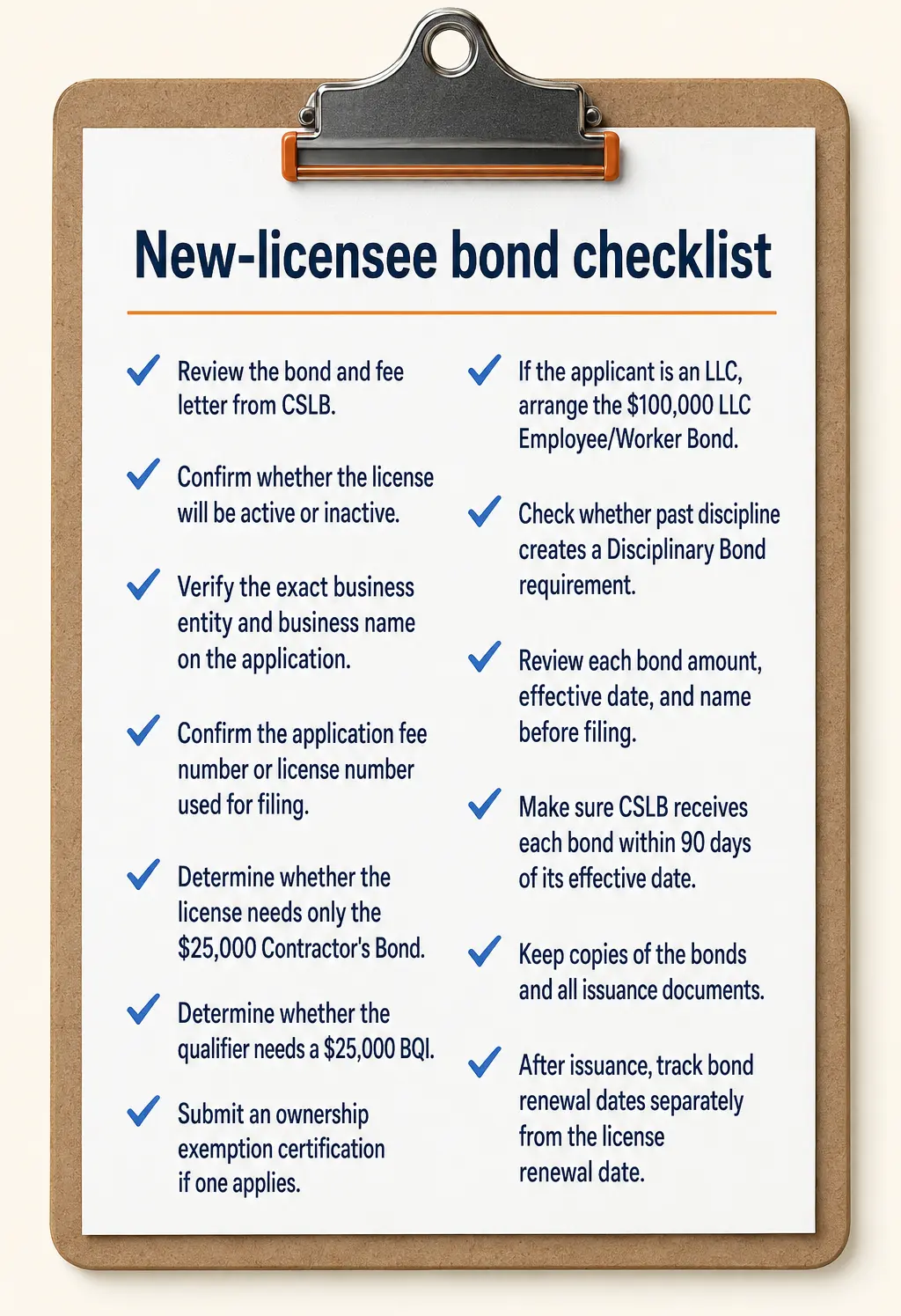
- California Contractor Bond Checklist for New Licensees
Passing the required exams is a major step toward getting a California contractor license, but it is not quite the finish line. Before the Contractors State License Board (CSLB) can issue an active license, most applicants must meet one or more bond requirements.
The basic rule is simple: nearly every active contractor license needs a $25,000 Contractor's Bond. Depending on the business type, the qualifier's role, and any past license discipline, additional bonds may also be required.
This guide explains the California contractor bond requirements that may apply to you and what to check before submitting your bond paperwork.
Quick Answer: Most new active licenses require a $25,000 Contractor's Bond. Some also require a $25,000 Bond of Qualifying Individual. A contractor license organized as an LLC generally needs an additional $100,000 LLC Employee/Worker Bond.
What Bonds Are Required for a California Contractor License?
California requires certain bonds before a contractor can hold an active license. CSLB checks that the correct bonds are on file. Private surety companies issue those bonds and handle any claims made against them.
The four main license bonds are:
- The $25,000 Contractor's Bond
- The $25,000 Bond of Qualifying Individual
- The $100,000 LLC Employee/Worker Bond
- A Disciplinary Bond, when required because of past license discipline
Not every contractor needs all four. Your requirements depend on how the business is organized, who qualifies the license, how much ownership that person has, and whether CSLB has imposed discipline.
These are license bonds. They are different from bid, performance, and payment bonds, which are tied to specific construction projects.
Why California Contractor Bond Requirements Matter for New Licensees
A bond problem can delay your license even after you have passed the exams. CSLB generally will not issue an active license until all required bonds are in place.
The responsibility continues after the license is issued. If a required bond is canceled and no replacement is filed, the license can be suspended. Any contracting performed during that suspension may be treated as unlicensed activity.
It is also important to know that a bond is not insurance for the contractor. A bond protects the people who are eligible to make a claim. If the surety company pays a valid claim, the contractor is generally responsible for paying the surety back.
What Is a California Contractor's License Bond?
A bond is a financial guarantee. In this case, the contractor purchases the bond, a private surety company backs it, and California requires it as part of active licensing. If an eligible consumer, employee, or other beneficiary has a valid claim covered by the bond, the surety may pay the claim up to the applicable limit. The contractor is then generally responsible for reimbursing the surety.
This is different from insurance. Insurance generally protects the policyholder against a covered loss. A contractor's license bond is designed to protect eligible consumers, employees, and other beneficiaries.
The Contractor's Bond is the basic bond required for an active California contractor license. The current bond amount is $25,000.
It must be in place before CSLB can:
- Issue an active license
- Reactivate an inactive license
- Renew an active license
An inactive license does not require a Contractor's Bond because the license holder cannot bid, contract, or perform work under that license.
The $25,000 amount is the bond's maximum stated amount, not what most contractors pay to buy it. A contractor normally pays a much smaller premium. The cost can depend on credit history, license history, and the surety company's underwriting rules.
New licensees who are ready to meet their bond requirements can request a quote for California contractor bonds through Pro-Builders Insurance Agency.
California Contractor Bond Types and Amounts
| Bond Type | Bond Amount | When it generally applies |
|---|---|---|
| Contractor's Bond | $25,000 | Required for nearly every active contractor license |
| Bond of Qualifying Individual | $25,000 | Required for certain qualifiers who are employees or do not meet an ownership exemption |
| LLC Employee/Worker Bond | $100,000 | Required for an active contractor license organized as an LLC |
| Disciplinary Bond | $25,000 to $250,000 | Required in certain cases involving prior license discipline |
The Bond of Qualifying Individual and LLC Employee/Worker Bond do not replace the standard Contractor's Bond. When they apply, they are required in addition to it.
When Is a California Bond of Qualifying Individual Required?
Every contractor license must have a qualifying individual, usually called the qualifier. This is the person whose experience and knowledge qualify the business for its license classification.
A Bond of Qualifying Individual, often shortened to BQI, is a separate $25,000 bond tied to that person. It is generally required when:
- The qualifier is a Responsible Managing Employee (RME).
- A corporation's qualifier is a Responsible Managing Officer (RMO) who owns less than 10 percent of the corporation's voting stock.
- An LLC's qualifier owns less than a 10 percent membership interest in the LLC.
- The qualifier does not otherwise qualify for an ownership-based exemption.
If more than one person qualifies the license, each qualifier must meet the bond rules that apply to that person.
How Ownership Structure Can Affect Bond Requirements
Ownership mainly affects whether the qualifier needs a Bond of Qualifying Individual. Here is how the rule usually works for each business type.
Bond Requirements for California Corporations
An RMO who owns at least 10 percent of the corporation's voting stock may qualify for an exemption from the BQI requirement. The RMO must certify that ownership to CSLB on the required form.
If the RMO owns less than 10 percent, the $25,000 BQI is generally required.
An RME normally needs the bond because an RME qualifies the license as an employee, not through the ownership exemption. Our guide to a CSLB corporation license covers the rest of the corporate application requirements.
Bond Requirements for California LLCs
An LLC qualifier who owns at least a 10 percent membership interest may qualify for the same type of exemption after certifying that ownership to CSLB.
If the qualifier owns less than 10 percent, the $25,000 BQI is generally required.
This exemption applies only to the qualifier bond. It does not remove the LLC's separate $100,000 Employee/Worker Bond requirement. Read more about how CSLB LLC requirements affect your contractor license application.
Bond Requirements for California Sole Owners
A sole owner who personally qualifies the license does not need a Bond of Qualifying Individual. The active license still needs the standard $25,000 Contractor's Bond.
If the sole owner uses an employee as the RME instead, that employee generally needs a BQI. For the full picture, see our guide to the sole proprietorship business structure for California contractors.
What Additional Bond Requirements Apply to LLC Licensees?
LLCs have one extra layer of bonding. An active contractor license organized as an LLC generally needs a $100,000 LLC Employee/Worker Bond in addition to the $25,000 Contractor's Bond.
This bond protects employees and workers if the LLC fails to pay certain amounts, including:
- Wages and interest on wages
- Fringe benefits
- Certain welfare and pension fund contributions
- Certain apprenticeship program contributions
The bond is not required while the LLC license is officially inactive.
Depending on the qualifier's ownership, a new active LLC could need all three of the following:
- $25,000 Contractor's Bond
- $100,000 LLC Employee/Worker Bond
- $25,000 Bond of Qualifying Individual
Together, that is $150,000 in bond coverage. The LLC normally pays premiums for the bonds rather than depositing the full $150,000.
How Bond Requirements Differ for Sole Owners, Corporations, and LLCs
| Business entity | Contractor's Bond | Bond of Qualifying Individual | Additional Entity Bond |
|---|---|---|---|
| Sole owner qualified by the owner | $25,000 | Not required | None |
| Corporation qualified by an RME | $25,000 | Required | None |
| Corporation qualified by an RMO with less than 10% ownership | $25,000 | Required | None |
| Corporation qualified by an RMO with at least 10% ownership | $25,000 | Exemption may be available | None |
| LLC with a qualifier owning less than 10% | $25,000 | Required | $100,000 |
| LLC with a qualifier owning at least 10% | $25,000 | Exemption may be available | $100,000 |
Partnerships follow a similar rule. A general partner who qualifies the partnership normally does not need a qualifier bond. An employee or other qualifier who is not a general partner generally does.
Which California Contractor Bonds Do You Need?
- Will the license be active?
If yes, start with the $25,000 Contractor's Bond. - Is the business an LLC?
If yes, add the $100,000 LLC Employee/Worker Bond. - Is the qualifier an RME?
If yes, a $25,000 Bond of Qualifying Individual is generally required. - Is the qualifier an RMO or LLC owner?
Check whether the person owns at least 10 percent and can claim the exemption. - Is there past CSLB discipline?
Check whether CSLB requires a separate Disciplinary Bond.
What Information Must Match on a California Contractor Bond?
The information on the bond must match CSLB's records exactly. Even a small difference can hold up license issuance.
Check the following:
- Exact business name
- Application fee number or license number, as applicable
- Bond amount
- Bond effective date
- Qualifier's full legal name, if the bond is a BQI
Exact means exact. For example, a bond for "Diamond Construction" may not be accepted if CSLB's records show "Diamond Construction, Inc."
The bond must also come from a surety company authorized by the California Department of Insurance, use an approved form, and include the required surety signature. The bond agency will usually handle these details, but the applicant should still review all identifying information before submission.
When Must California Contractor Bonds Be Filed With CSLB?
After an applicant passes the required exams, CSLB sends a bond and fee letter explaining what is still needed before the license can be issued. This may include bonds, the initial license fee, workers' compensation documents, and other items.
Once you know which bonds are required, Pro-Builders Insurance Agency can use your application fee number to help you obtain the correct bonds and arrange filing with CSLB.
Pay close attention to the bond's effective date. CSLB must receive an acceptable bond within 90 days of that effective date. This is a bond-filing rule, not a general statement that every issuance requirement is due within 90 days after the exam.
New licensees should also know that:
- A required bond must be accepted before an active license can be issued.
- A bond term may not match the two-year license term.
- Only one bond of the same type can be in effect at a time.
- Filing a second bond for the same period can cancel the first bond.
- A replacement bond should begin on the same date the old bond ends.
- A gap in bond coverage can suspend the license.
If a surety company cancels a bond, the cancellation generally takes effect 30 days after CSLB receives the cancellation notice. Do not wait until the suspension date to fix the problem.
Common Mistakes To Avoid With California Contractor Bond Requirements
Assuming the $25,000 Bond Is the Only Requirement
The standard Contractor's Bond may be only the first requirement. LLCs and licenses using certain qualifiers may need additional bonds.
Confusing the Bond Amount With Its Price
A $25,000 bond does not usually cost $25,000. The contractor normally pays a premium for that amount of bond coverage.
Using a Different Business Name
The name on the bond must match CSLB's records exactly, including words such as "Inc." or "LLC."
Forgetting the Qualifier Bond
A corporation or LLC may have its business bonds in place and still be missing the separate BQI required for its qualifier.
Assuming the Ownership Exemption Is Automatic
The qualifier must meet the ownership threshold and submit the required certification. CSLB does not apply the exemption automatically.
Missing a Bond Renewal
Bond and license renewal dates often do not match. Track both dates so the license does not fall into suspension.
Treating the Bond Like Insurance
The bond protects eligible claimants, not the contractor. If the surety pays a valid claim, the contractor is generally responsible for repayment.
What New Licensees Should Know About Bond Alternatives and Cash Deposits
Buying a surety bond is not the only way to meet the requirement. CSLB allows an applicant or licensee to provide an approved deposit for the full bond amount instead.
CSLB currently accepts only:
- A cashier's check
- A bank-certified check
The check must be made payable to the Contractors State License Board and include the identifying information CSLB requires. A check submitted in place of a BQI must also identify the qualifier.
CSLB does not accept ordinary cash, personal checks, certificates of deposit, savings account passbooks, or credit union certificates for this purpose.
The biggest tradeoff is that the full amount remains tied up. Even after the license expires or becomes inactive, CSLB generally holds the deposit for three years. A pending claim can delay its release even longer.
Before choosing this option, compare the cost of a bond premium with the effect of placing $25,000, $100,000, or more under CSLB's control. See CSLB Bond Alternatives for the current rules.
How To Prepare for California Contractor Bond Requirements Before License Issuance
If you are still working through the application or exam process, Contractors Intelligence School can help with application assistance, Law & Business exam preparation, and trade exam preparation.
Once CSLB assigns your application fee number, Pro-Builders Insurance Agency can help identify and obtain the bonds and insurance coverage needed for license issuance.
| Where are you in the licensing process? | Resource |
|---|---|
| Preparing your application or studying for the CSLB exams | Contractors Intelligence School |
| Received your issuance letter and need a contractor bond | Pro-Builders Insurance Agency |
| Need to confirm an official licensing requirement | Contractors State License Board |
California Contractor Bond Checklist for New Licensees
For most new active licenses, the starting point is a $25,000 Contractor's Bond. Whether you need more depends on the business type and the qualifier's role and ownership.
A sole owner who personally qualifies the license may need only the standard bond. A corporation using an RME or an RMO with less than 10 percent ownership will generally need a separate Bond of Qualifying Individual. An active LLC needs the additional $100,000 LLC Employee/Worker Bond and may also need a BQI.
The best way to avoid delays is to read the CSLB bond and fee letter carefully, make sure every name and number matches, and arrange the required bonds early enough to correct any errors before issuance.
Ready to complete the California contractor licensing process?
Contractors Intelligence School can help with the application and prepare you for the Law & Business and trade exams. When you reach the bond and insurance stage, Pro-Builders Insurance Agency can help you obtain the required bonds and coverage for license issuance.
Disclaimer: This article provides general educational information. Requirements can vary based on the business entity, qualifier arrangement, disciplinary history, and current CSLB instructions.
Published on: August 18, 2026



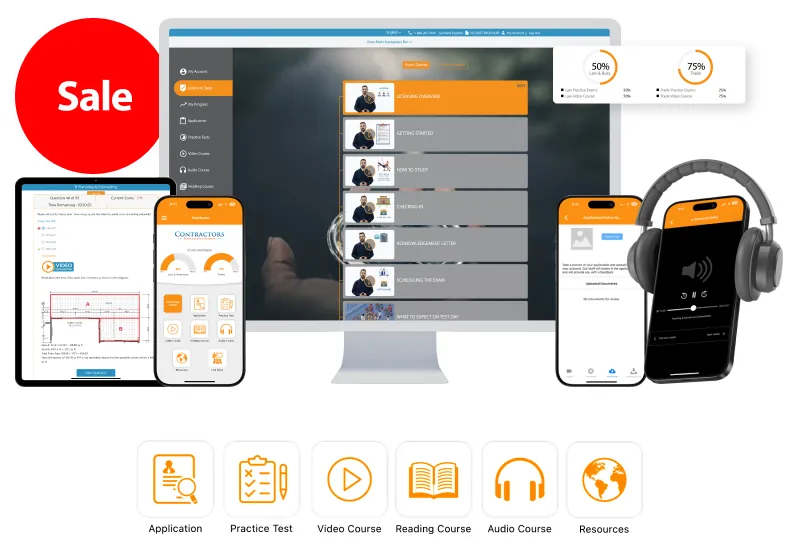
 $495.00

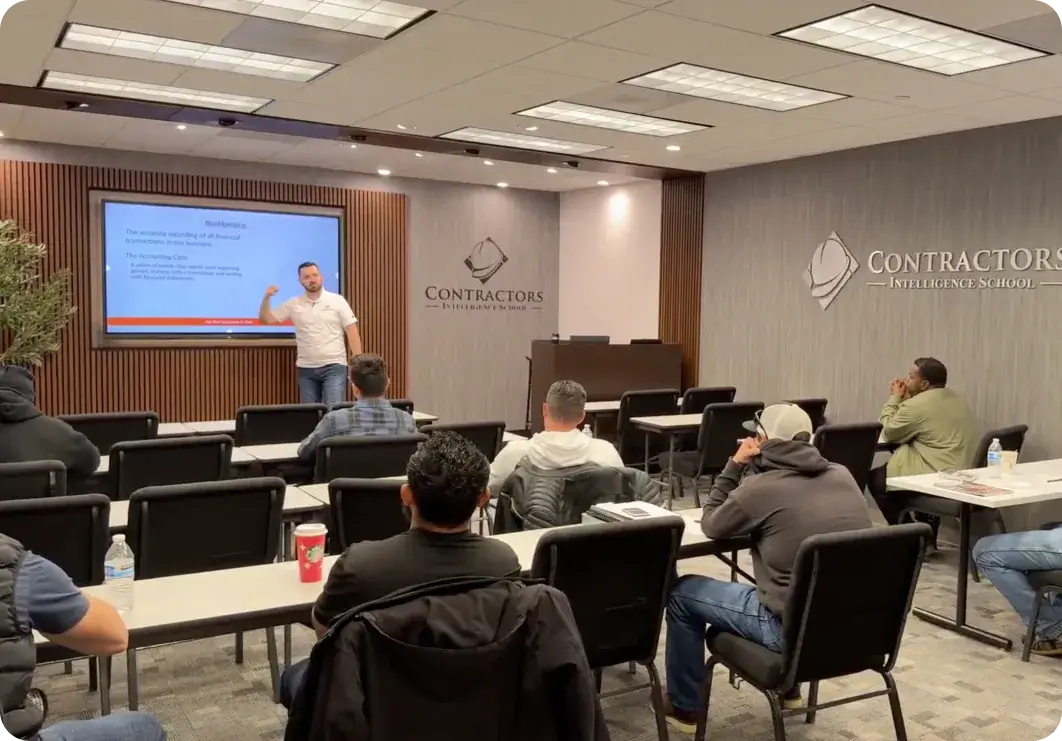
 Live Streaming Class


 Limited Time Offer | Save $500
 Full Online Course